✦ Audio stories for kids ✦
The Secret Hatch of Luis Vives: Mission Center of the Earth — read aloud
Read by Ana (US · child voice) · 7:05 · 1011 words · 1 plays
Tap any word to jump to it.
The Secret Hatch of Luis Vives: Mission Center of the Earth
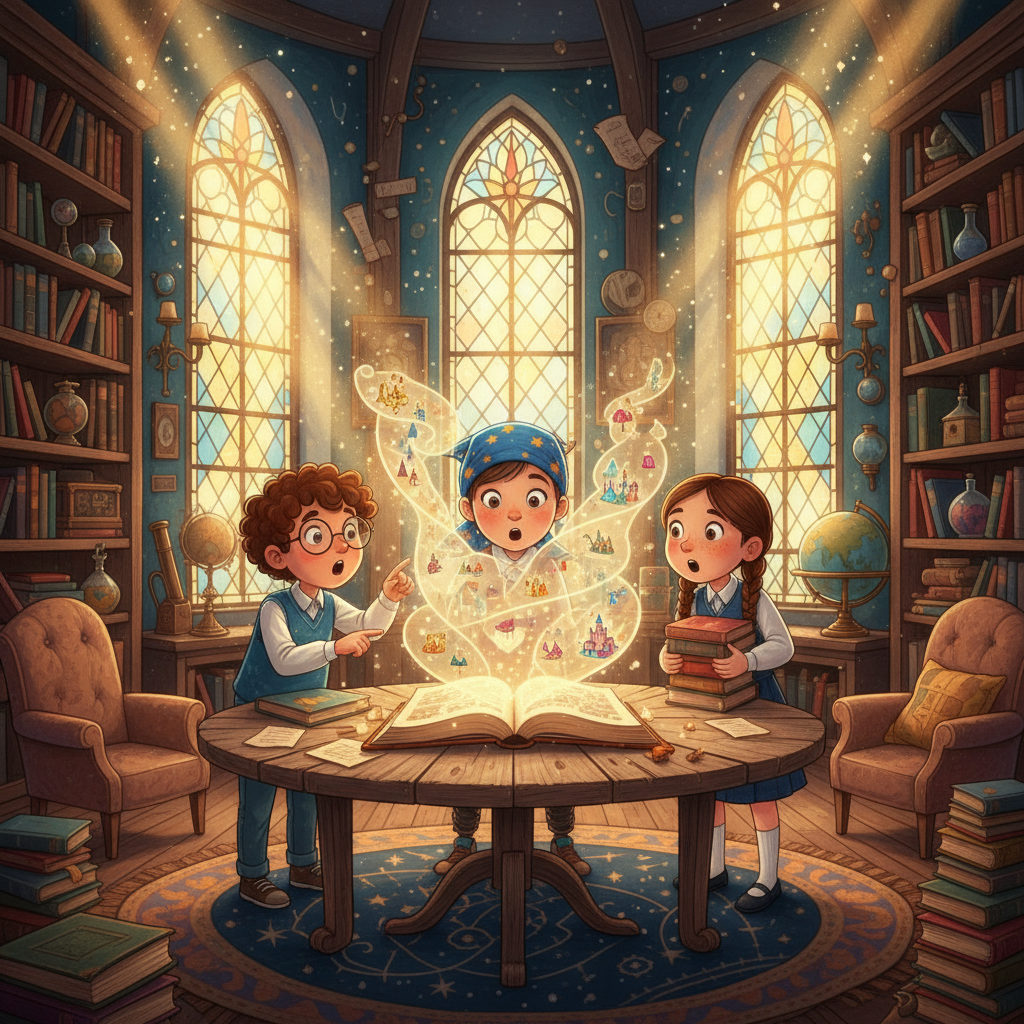
It was an apparently ordinary Tuesday morning at Luis Vives School. The fourth-grade students were in the library, a place that smelled of old paper and adventures waiting to be lived. The librarian, Mrs. Gertrudis, had taken out a box of donated books that had not yet been sorted. Among math books and dusty dictionaries, a boy named Lucas found a worn leather-bound volume with golden letters that barely gleamed: Journey to the Center of the Earth, by Jules Verne.
—Look at this! —Lucas exclaimed, drawing the attention of his classmates, Martina and Mateo. When they opened the book, they found not just words, but a folded map that seemed to have been drawn by hand with an unusually blue ink. It was not a map of Spain, nor even of Europe; it showed tunnels, crystal caves, and an inner sea that seemed to defy the laws of physics.
Suddenly, the lights in the library flickered. The map began to glow softly, and to the surprise of the three friends, the letters of the book started to float in the air, forming a phrase on the carpet: The descent begins beneath the old oak. The children looked at each other with wide eyes. The old oak was the oldest tree in the courtyard of Luis Vives School, the one the teachers always said had roots that reached the foundations of the world.
Taking advantage of recess, Lucas, Martina, and Mateo ran toward the tree. Upon arrival, they noticed that among the twisted roots there was a wooden hatch hidden by moss. With a combined effort, they lifted the heavy cover and discovered a spiral staircase that disappeared into absolute darkness. Armed with Martina's phone flashlight and a snack bag, they decided that a student of Luis Vives would not back down from a mystery of Jules Verne.
The descent was long. As they went down, the air became cooler and smelled of damp earth and ancient minerals. Suddenly, the staircase ended and they found themselves in a gallery of colossal proportions. The walls were not gray stone, but giant quartz that reflected the light of their flashlight in a thousand colors. They had entered the world that Verne had described, but it was right beneath their school.
—It's incredible! —Martina whispered. Look at those formations, they look like crystal buildings.
They continued walking and arrived at a forest of giant mushrooms. Violet and orange mushrooms, as tall as street lamps, illuminated the path with a soft bioluminescence. There, they met a small reptile with shimmering scales, a kind of prehistoric lizard that seemed to have no fear of humans. Mateo named it Verne in honor of the author. The little creature seemed to want to guide them in a specific direction.
Following Verne, the children arrived at the shore of an underground sea. The water was electric blue and had no waves, only small ripples that shimmered as if they contained stars. On the shore, they found a wooden pine raft that seemed to have been waiting there for centuries. Without hesitation, they climbed aboard. The wind, blowing from the depths, gently pushed them toward the center of the lake.
Suddenly, the water began to stir. Two long, elegant necks emerged from the bottom: they were plesiosaurs, creatures that the Verne book mentioned in detail. However, instead of being fierce, the animals played around the raft, jumping and splashing the children with warm water. Lucas took out the map and realized they were at the exact point where the book said time stopped.
—Guys, we need to find the exit before recess ends —Mateo warned, looking at his wristwatch, which now spun backward. If time here is different, we could get stuck in the 19th century.
Following the map's instructions, they found a natural ventilation chimney that rose vertically upward. But there was a problem: it was too high. That was when they remembered an experiment they had done in science class about air pressure. Using their backpacks and some plastic bags they had brought, they improvised a small hot air balloon using a jet of steam coming from a thermal crack.
The ascent was dizzying. The makeshift balloon lifted them through a narrow tunnel filled with trilobite fossils and petrified ferns. The heat increased, but the excitement of the adventure kept them united. Just when they thought they couldn't go up any further, a blinding white light appeared above their heads.
With a loud thud, they landed on a pile of dry leaves. When they opened their eyes, they realized they were back in the schoolyard, right behind the oak tree. The hatch was no longer there, and the book Lucas held in his hands now had blank pages, except for a final dedication that appeared by magic: For the explorers of Luis Vives, who know that reality is only the beginning of imagination.
The bell rang, announcing the end of recess. The three friends shook the dust from their knees and looked at each other conspiratorially. They entered the classroom just in time for Geography class. When the teacher began to talk about the layers of the Earth (crust, mantle, and core), Martina raised her hand with a mischievous smile.
—Teacher —she said —you forgot to mention the forest of giant mushrooms and the sea of plesiosaurs.
The whole class laughed, thinking it was a joke, but Lucas, Martina, and Mateo exchanged a shared secret glance. In their pockets, they still kept small pieces of sparkling quartz that did not belong to this world, and in their hearts, the certainty that Jules Verne did not just write fiction, but a travel guide for those who dare to look beyond the obvious. From that day on, the library at Luis Vives School became the favorite place of the fourth graders, because now they knew that every book is a door, and that beneath their feet, the world is much bigger and more wonderful than the maps dare to draw.
Same story, other voices
More read-aloud stories
 🇺🇸 2:50
Maya’s Brave Swim
Read by Jenny (US)
11 plays · 370 words
 🇺🇸 4:53
Milo and the Fallen Star of Whispering Woods
Read by Sonia (UK)
4 plays · 829 words
 🇺🇸 3:38
The Little Bunny and the Lost Star
Read by Ana (US · child voice)
4 plays · 499 words
 🇺🇸 4:00
Three Little Pigs Story Images: A Warm and Whimsical Tale
Read by Ana (US · child voice)
4 plays · 570 words
 🇺🇸 3:18
Leo and the Shiny Prize
Read by Ana (US · child voice)
4 plays · 382 words
 🇺🇸 5:35
Leo and the Truth-Seeker System
Read by Ana (US · child voice)
3 plays · 742 words
 🇺🇸 2:54
The Weaver of Wires and the Static Shadow
Read by Guy (US)
3 plays · 459 words
 🇺🇸 1:58
The Disobedient Boy
Read by Ana (US · child voice)
3 plays · 277 words